Thousands of images per season
Large marine mammal surveys accumulate image collections faster than they can be filtered, reviewed, and linked back to survey context.
PelAtlas structures and scales marine mammal photo-identification workflows, built around structured human annotation and designed to evolve toward ML-assisted decision support.
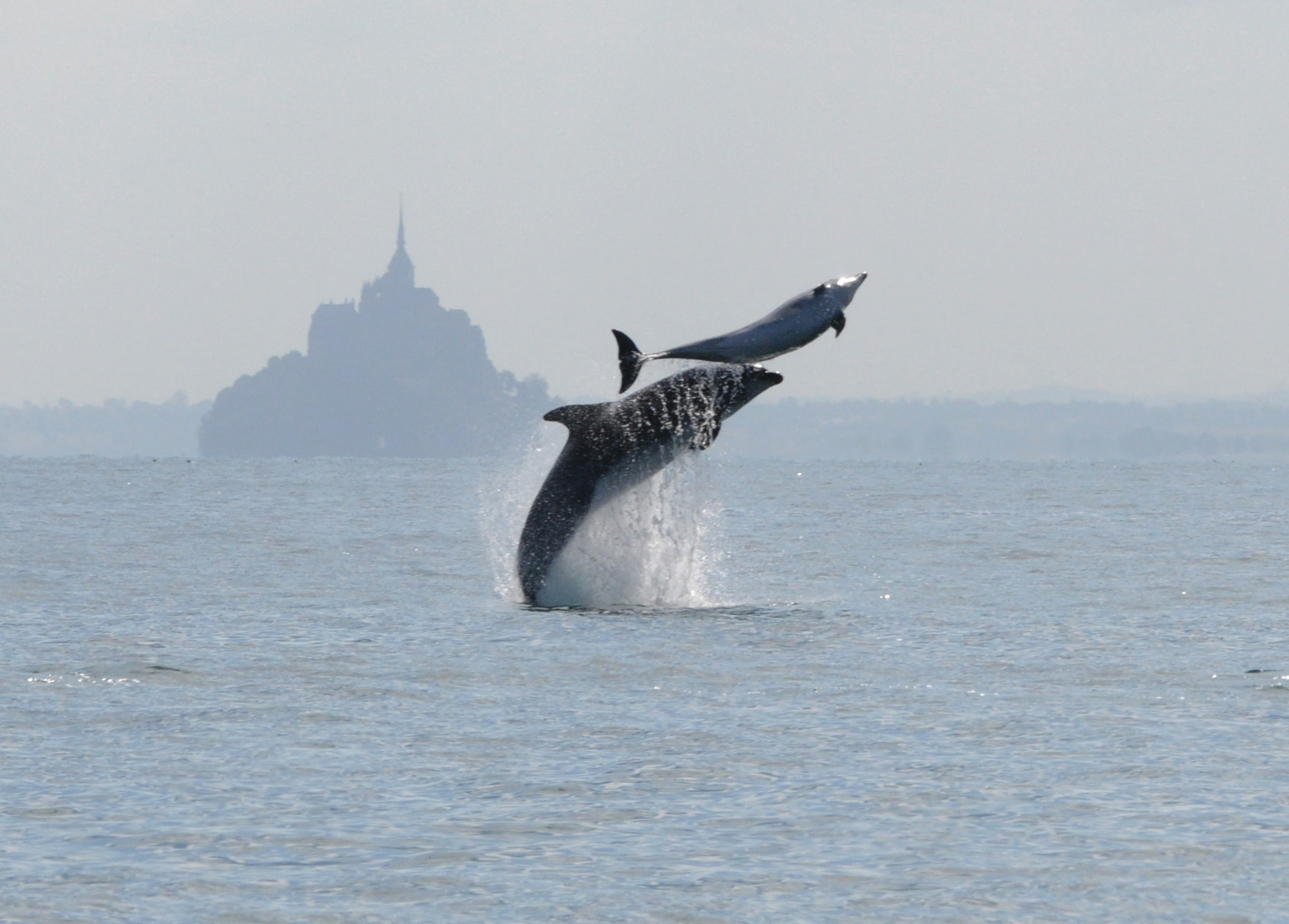
© Association AL LARK

Photo-identification workflows break down at scale.
Large-scale marine mammal surveys generate more imagery than can be consistently filtered, reviewed, and integrated into long-term catalogs using manual workflows.
Large marine mammal surveys accumulate image collections faster than they can be filtered, reviewed, and linked back to survey context.
Researchers spend substantial time separating useful imagery from noise and comparing individuals against existing catalogs.
Long-term identity decisions need provenance, repeatable review, and careful handling of uncertainty across seasons and teams.
PelAtlas replaces fragmented processing with maintainable research infrastructure that supports auditability, long-term catalog maintenance, and future model-assisted workflows.
Structured workflows instead of ad-hoc processing
Move from fragmented file handling to repeatable research operations.
Traceable decisions and provenance
Keep evidence and catalog changes understandable over time.
Human validation remains central
Identity decisions stay reviewable and accountable to researchers.
Designed to integrate ML incrementally
Add assistance features carefully without losing scientific control.
Current and planned functionality of the PelAtlas platform
Organizing surveys, imagery, and provenance for durable research datasets.
Structured import of surveys, images, sightings, and metadata into a shared research workflow.
Browse, filter, and inspect large survey image collections with dataset context preserved.
Supporting structured human review, collaboration, and validation.
Manual annotation with explicit review states, evidence capture, and traceable outcomes.
Shared queues and team-oriented review flows for structured annotation and validation.
Task distribution to broader contributor groups with quality control and validation checkpoints.
Planning for model-assisted triage, retrieval, and active learning.
Automatic triage of relevant imagery to reduce the initial manual screening workload.
Detection of identity-relevant regions, such as dorsal fins, to support downstream review.
Retrieval of likely matches to support open-set review instead of forcing a closed-set answer.
Model-guided prioritization of the most informative images for efficient annotation effort.
PelAtlas is designed around practical review tasks, from dataset triage to detailed annotation and image comparison.
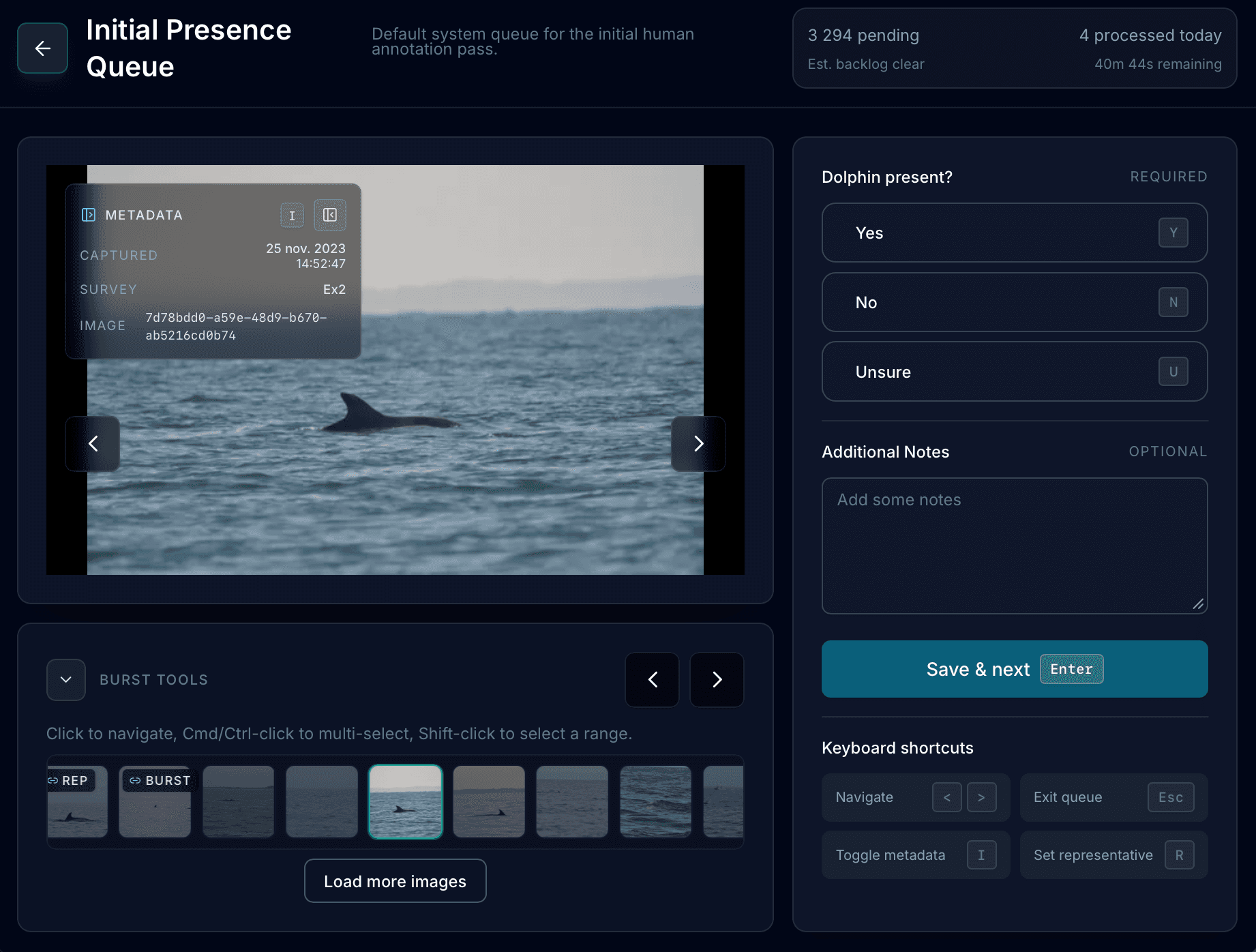
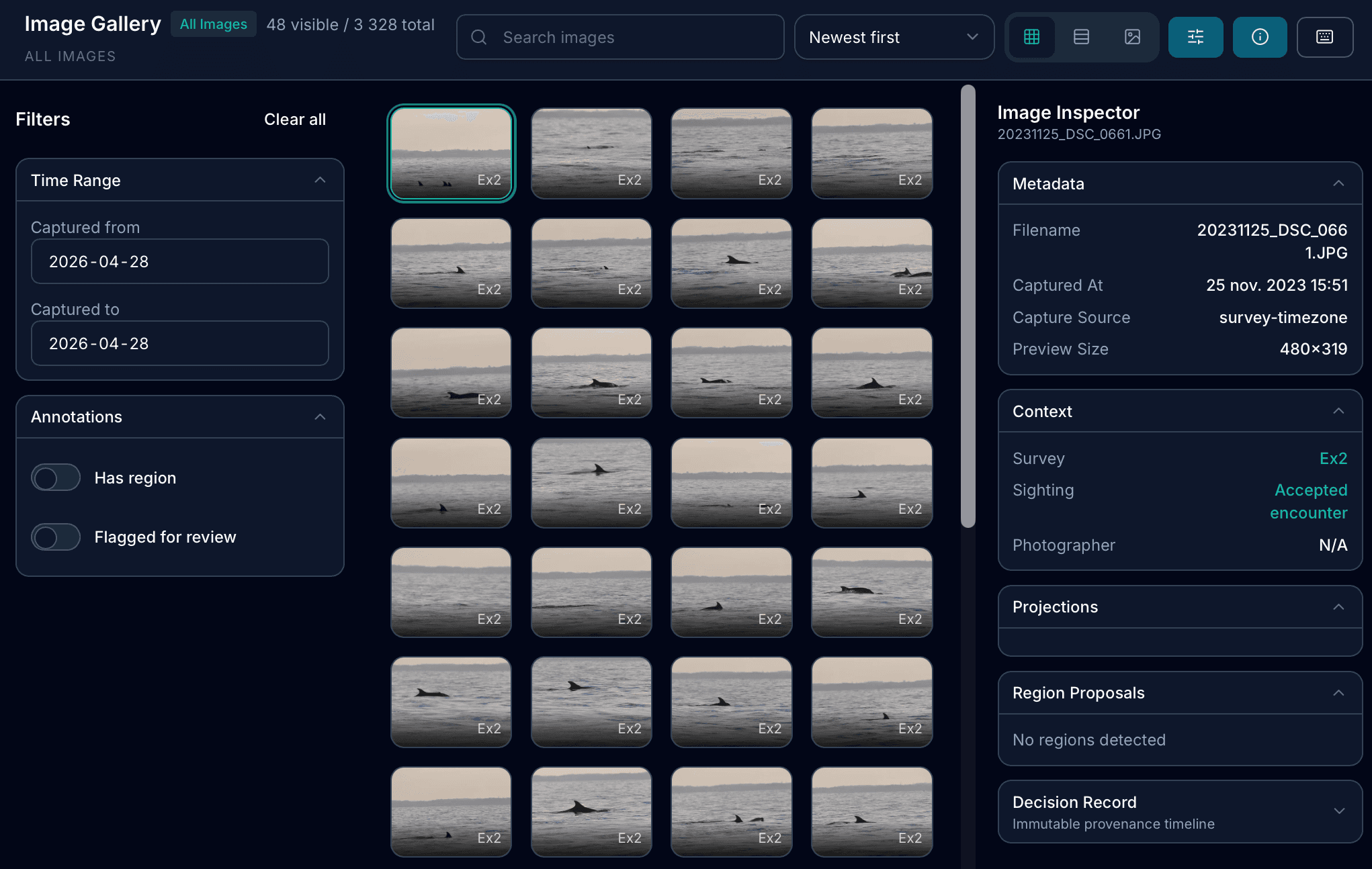
The platform is aligned with scientific workflows where expert review remains central and machine learning is introduced as support rather than opaque automation.
PelAtlas is built for decision support, with experts confirming matches, unknowns, and uncertain cases.
Reviews happen through explicit workflow steps so evidence, rationale, and outcomes remain auditable.
As assistance features mature, they can reduce workload while preserving traceability and scientific control.
ML-assisted identification workflow (in development)
Step 1
Image filtering
Surface relevant survey imagery before deeper review begins.
Step 2
Identity evidence extraction
Locate dorsal-fin evidence and other identity-relevant regions.
Step 3
Candidate retrieval
Compare likely matches without forcing a closed-set answer.
Step 4
Expert validation
Expert review confirms matches, new individuals, and uncertainty.
This process is currently under development
Reliable identity decisions support population estimation and demographic analysis.
Structured historical records help track abundance, site fidelity, movement and distribution across seasons and years.
Connecting catalogs across institutions enables the study of population connectivity and supports conservation at broader geographic scales.
Traceable workflows and preserved provenance make methods easier to review, reuse, and trust.
Whether you're working with long-term survey data or building a new catalog, PelAtlas provides the infrastructure for structured, scalable photo-identification research.